In Private Equity and Capital Markets, a firm’s data maturity is often limited by its most recent acquisition. When you acquire a new Portfolio Company (PortCo), you aren’t just buying an asset; you are inheriting a legacy data stack. One company might run on a modern cloud-based CRM, while another relies on a 15-year-old on-premise SAP instance, and a third runs its entire operation on fragmented Excel sheets.
Unlike public market firms with large in-house technology teams, PE firms typically operate with lean IT and BI resources. As a result, they depend heavily on external service providers to aggregate data and build dashboards. When those providers lack deep understanding of PE-specific data, metrics, and reporting conventions, the entire reporting function becomes a liability rather than an asset.
Because these systems don’t communicate, your ability to see a unified view of the portfolio is dragged down by the messiest stack in the group. This is the “Lowest Common Denominator” Problem: if you have ten companies and nine are automated, but the tenth requires a week of manual data entry, your entire fund-level report is delayed by a week. Your firm is only as fast as its most manual process.
Firms usually try to solve this in one of two ways, both of which struggle with the reality of M&A:
The Rigid Warehouse: Forcing every PortCo to map their data into a fixed central schema. This is expensive, slow, and breaks every time a PortCo updates their local system.
The Unstructured Lake: Dumping raw data into a central repository. This results in a “Data Swamp” where the Deal Team can’t find a single version of the truth because the metadata is missing.
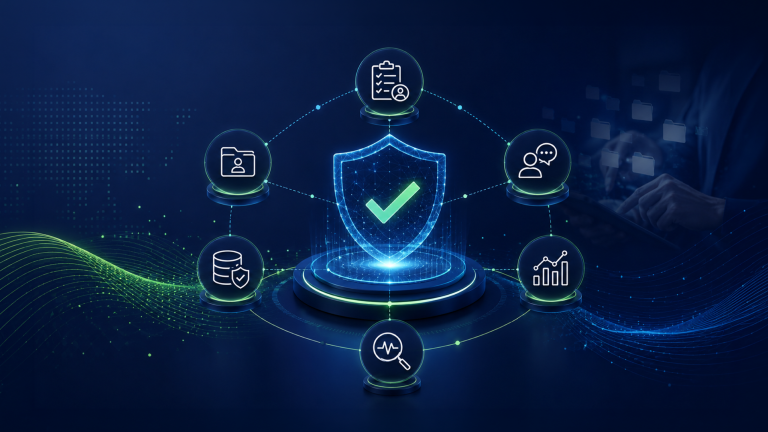
To achieve true Pro-Forma Visibility and AI-Readiness, firms need a third path. This is the FocusLake, which is a purpose-built architectural layer designed to turn fragmented data from ERP, CRM, and accounting systems into high-velocity, governed assets without requiring a total overhaul of the PortCo’s local stack.
In a Private Equity environment, data is generated by companies with different tech stacks, accounting standards, and reporting cadences. Traditional Data Warehouses require manual ETL (Extract, Transform, Load) processes to “force” these disparate systems into a single format.
This creates Architectural Fragility. If one portfolio company switches from QuickBooks to NetSuite, or changes their “Churn” definition, the entire fund-level pipeline breaks. The FocusLake allows for the flexibility of a lake, storing PortCo data in its native format, while maintaining the strict governance required for fund-level reporting.
The “Focus” in FocusLake refers to its ability to preserve Investment Context. When data is moved from a PortCo’s CRM into a typical warehouse, it often loses the specific metadata like customer segment or region that explains the “why” behind the performance.
DataFocus by ThoughtFocus utilizes a Semantic Ingestion Layer to ensure data remains connected to the investment thesis:
Dynamic Schema Mapping: Unlike rigid warehouses, the FocusLake adapts to changes in PortCo systems without breaking the fund’s master dashboards.
Unified Semantic Layer: It creates a “Single Version of Truth.” Whether it’s the Deal Team looking at “EBITDA” or the LP Reporting team looking at “Net IRR,” they are looking at the exact same data points sourced from a unified FocusLake.
30-Minute Refresh Cycles: In a fast-moving market, “Day-After” reporting is a liability. The FocusLake architecture supports near real-time synchronization, allowing leaders to act on performance shifts as they happen.
When the central data team cannot provide real-time visibility into portfolio performance, teams build an “Excel Bridge,” which consists of disconnected spreadsheets used to manually join data from multiple companies. This creates massive security risks and “Data Drift” where the fund’s master report doesn’t match the PortCo’s internal numbers. The impact is felt most acutely during time-sensitive activities such as deal analysis, quarterly closes, and LP reporting cycles.
By providing Reporting as a Service (RaaS) through a FocusLake, the CTO reclaims control. You aren’t just giving users data; you are giving them a Governed Sandbox. They get the freedom of self-service, but the data is sourced from a secure, validated, and normalized FocusLake.
For PE firms, this means a predictable, fixed-cost engagement. ThoughtFocus builds and maintains your reports as an ongoing managed service, with SLA-driven operations that cover monitoring, enhancements, and support for data pipelines and dashboards under clearly defined service levels. This eliminates the need for PE firms to build or scale large internal BI teams.
The most significant benefit of a FocusLake is its role as the foundation for Agentic AI. Predictive analytics and automated portfolio valuations require Contextual Data. If your AI doesn’t understand the relationship between a PortCo’s CRM pipeline and the fund’s capital call schedule, its insights will be superficial.
The FocusLake provides the interoperability required for AI to navigate complex financial systems and provide accurate, cross-functional recommendations.
Multi-Entity Connectors: Pre-built integration for diverse ERPs (NetSuite, Sage, Microsoft Dynamics) to harmonize reporting across the portfolio.
Schema-on-Read Capability: Maintain data flexibility for various PortCo reporting styles while ensuring structured outputs for LPs.
Automated Normalization: Instantly convert disparate currencies and fiscal calendars into a unified fund-level standard.
Domain-Aware Reporting: Dashboards and reports designed specifically for PE use cases, delivered through Power BI or Tableau. These include Cash Flows, Dry Powder, Management Fee, Fund Performance, and Portfolio Company Operational KPIs.
Is your data architecture built for the next decade of AI?
Schedule a Technical Deep-Dive to see how the FocusLake, already deployed and production-proven, can eliminate reporting disparities across your portfolio.